Monday, July 12, 2010

The Three Robes

Long, long ago, a king and queen reigned over a large and powerful country. What their names were nobody knows, but their son was called Sigurd, and their daughter Lineik, and these young people were famed throughout the whole kingdom for their wisdom and beauty.
There was only a year between them, and they loved each other so much that they could do nothing apart. When they began to grow up the king gave them a house of their own to live in, with servants and carriages, and everything they could possibly want.
For many years they all lived happily together, and then the queen fell ill, and knew that she would never get better.
"Promise me two things," she said one day to the king; "one, that if you marry again, as indeed you must, you will not choose as your wife a woman from some small state or distant island, who knows nothing of the world, and will be taken up with thoughts of her grandeur. But rather seek out a princess of some great kingdom, who has been used to courts all her life, and holds them at their true worth. The other thing I have to ask is, that you will never cease to watch over our children, who will soon become your greatest joy."
These were the queen's last words, and a few hours later she was dead. The king was so bowed down with sorrow that he would not attend even to the business of the kingdom, and at last his Prime Minister had to tell him that the people were complaining that they had nobody to right their wrongs. "You must rouse yourself, sir," went on the minister, "and put aside your own sorrows for the sake of your country."
"You do not spare me," answered the king; "but what you say is just, and your counsel is good. I have heard that men say, likewise, that it will be for the good of my kingdom for me to marry again, though my heart will never cease to be with my lost wife. But it was her wish also; therefore, to you I entrust the duty of finding a lady fitted to share my throne; only, see that she comes neither from a small town nor a remote island."
So an embassy was prepared, with the minister at its head, to visit the greatest courts in the world, and to choose out a suitable princess. But the vessel which carried them had not been gone many days when a thick fog came on, and the captain could see neither to the right nor to the left. For a whole month the ship drifted about in darkness, till at length the fog lifted and they beheld a cliff jutting out just in front. On one side of the cliff lay a sheltered bay, in which the vessel was soon anchored, and though they did not know where they were, at any rate they felt sure of fresh fruit and water.
The minister left the rest of his followers on board the ship, and taking a small boat rowed himself to land, in order to look about him and to find out if the island was really as deserted as it seemed.
He had not gone far, when he heard the sound of music, and, turning in its direction, he saw a woman of marvellous beauty sitting on a low stool playing on a harp, while a girl beside her sang. The minister stopped and greeted the lady politely, and she replied with friendliness, asking him why he had come to such an out-of-the way place. In answer he told her of the object of his journey.
"I am in the same state as your master," replied the lady; "I was married to a mighty king who ruled over this land, till Vikings [sea-robbers] came and slew him and put all the people to death. But I managed to escape, and hid myself here with my daughter."
And the daughter listened, and said softly to her mother: "Are you speaking the truth now?"
"Remember your promise," answered the mother angrily, giving her a pinch which was unseen by the minister.
"What is your name, madam?" asked he, much touched by this sad story.
"Blauvor," she replied "and my daughter is called Laufer"; and then she inquired the name of the minister, and of the king his master. After this they talked of many things, and the lady showed herself learned in all that a woman should know, and even in much that men only were commonly taught. "What a wife she would make for the king," thought the minister to himself, and before long he had begged the honour of her hand for his master. She declared at first that she was too unworthy to accept the position offered her, and that the minister would soon repent his choice; but this only made him the more eager, and in the end he gained her consent, and prevailed on her to return with him at once to his own country.
The minister then conducted the mother and daughter back to the ship; the anchor was raised, the sails spread, and a fair wind was behind them.
Now that the fog had lifted they could see as they looked back that, except just along the shore, the island was bare and deserted and not fit for men to live in; but about that nobody cared. They had a quick voyage, and in six days they reached the land, and at once set out for the capital, a messenger being sent on first by the minister to inform the king of what had happened.
When his Majesty's eyes fell on the two beautiful women, clad in dresses of gold and silver, he forgot his sorrows and ordered preparations for the wedding to be made without delay. In his joy he never remembered to inquire in what kind of country the future queen had been found. In fact his head was so turned by the beauty of the two ladies that when the invitations were sent by his orders to all the great people in the kingdom, he did not even recollect his two children, who remained shut up in their own house!
After the marriage the king ceased to have any will of his own and did nothing without consulting his wife. She was present at all his councils, and her opinion was asked before making peace or war. But when a few months had passed the king began to have doubts as to whether the minister's choice had really been a wise one, and he noticed that his children lived more and more in their castle and never came near their stepmother.
It always happens that if a person's eyes are once opened they see a great deal more than they ever expected; and soon it struck the king that the members of his court had a way of disappearing one after the other without any reason. At first he had not paid much attention to the fact, but merely appointed some fresh person to the vacant place. As, however, man after man vanished without leaving any trace, he began to grow uncomfortable and to wonder if the queen could have anything to do with it.
Things were in this state when, one day, his wife said to him that it was time for him to make a progress through his kingdom and see that his governors were not cheating him of the money that was his due. "And you need not be anxious about going," she added, "for I will rule the country while you are away as carefully as you could yourself."
The king had no great desire to undertake this journey, but the queen's will was stronger than his, and he was too lazy to make a fight for it. So he said nothing and set about his preparations, ordering his finest ship to be ready to carry him round the coast. Still his heart was heavy, and he felt uneasy, though he could not have told why; and the night before he was to start he went to the children's castle to take leave of his son and daughter.
He had not seen them for some time, and they gave him a warm welcome, for they loved him dearly and he had always been kind to them. They had much to tell him, but after a while he checked their merry talk and said:
"If I should never come back from this journey I fear that it may not be safe for you to stay here; so directly there are no more hopes of my return go instantly and take the road eastwards till you reach a high mountain, which you must cross. Once over the mountain keep along by the side of a little bay till you come to two trees, one green and the other red, standing in a thicket, and so far back from the road that without looking for them you would never see them. Hide each in the trunk of one of the trees and there you will be safe from all your enemies."
With these words the king bade them farewell and entered sadly into his ship. For a few days the wind was fair, and everything seemed going smoothly; then, suddenly, a gale sprang up, and a fearful storm of thunder and lightning, such as had never happened within the memory of man. In spite of the efforts of the frightened sailors the vessel was driven on the rocks, and not a man on board was saved.
That very night Prince Sigurd had a dream, in which he thought his father appeared to him in dripping clothes, and, taking the crown from his head, laid it at his son's feet, leaving the room as silently as he had entered it.
Hastily the prince woke up his sister Lineik, and they agreed that their father must be dead, and that they must lose no time in obeying his orders and putting themselves in safety. So they collected their jewels and a few clothes and left the house without being observed by anyone.
They hurried on till they arrived at the mountain without once looking back. Then Sigurd glanced round and saw that their stepmother was following them, with an expression on her face which made her uglier than the ugliest old witch. Between her and them lay a thick wood, and Sigurd stopped for a moment to set it on fire; then he and his sister hastened on more swiftly than before, till they reached the grove with the red and green trees, into which they jumped, and felt that at last they were safe.
Now, at that time there reigned over Greece a king who was very rich and powerful, although his name has somehow been forgotten. He had two children, a son and a daughter, who were more beautiful and accomplished than any Greeks had been before, and they were the pride of their father's heart.
The prince had no sooner grown out of boyhood than he prevailed on his father to make war during the summer months on a neighbouring nation, so as to give him a chance of making himself famous. In winter, however, when it was difficult to get food and horses in that wild country, the army was dispersed, and the prince returned home.
During one of these wars he had heard reports of the princess Lineik's beauty, and he resolved to seek her out, and to ask for her hand in marriage. All this Blauvor, the queen, found out by means of her black arts, and when the prince drew near the capital she put a splendid dress on her own daughter and then went to meet her guest.
She bade him welcome to her castle, and when they had finished supper she told him of the loss of her husband, and how there was no one left to govern the kingdom but herself.
"But where is the princess Lineik?" asked the prince when she had ended her tale.
"Here," answered the queen, bringing forward the girl, whom she had hitherto kept in the background.
The prince looked at her and was rather disappointed. The maiden was pretty enough, but not much out of the common.
"Oh, you must not wonder at her pale face and heavy eyes," said the queen hastily, for she saw what was passing in his mind. "She has never got over the loss of both father and mother."
"That shows a good heart," thought the prince; "and when she is happy her beauty will soon come back." And without any further delay he begged the queen to consent to their betrothal, for the marriage must take place in his own country.
The queen was enchanted. She had hardly expected to succeed so soon, and she at once set about her preparations. Indeed she wished to travel with the young couple, to make sure that nothing should go wrong; but here the prince was firm, that he would take no one with him but Laufer, whom he thought was Lineik.
They soon took leave of the queen, and set sail in a splendid ship; but in a short time a dense fog came on, and in the dark the captain steered out of his course, and they found themselves in a bay which was quite strange to all the crew. The prince ordered a boat to be lowered, and went on shore to look about him, and it was not long before he noticed the two beautiful trees, quite different from any that grew in Greece. Calling one of the sailors, he bade him cut them down, and carry them on board the ship. This was done, and as the sky was now clear they put out to sea, and arrived in Greece without any more adventures.
The news that the prince had brought home a bride had gone before them, and they were greeted with flowery arches and crowns of coloured lights. The king and queen met them on the steps of the castle, and conducted the girl to the women's house, where she would have to remain until her marriage. The prince then went to his own rooms and ordered that the trees should be brought in to him.
The next morning the prince bade his attendants bring his future bride to his own apartments, and when she came he gave her silk which she was to weave into three robes – one red, one green, and one blue – and these must all be ready before the wedding. The blue one was to be done first and the green last, and this was to be the most splendid of all, "for I will wear it at our marriage," said he.
Left alone, Laufer sat and stared at the heap of shining silk before her. She did not know how to weave, and burst into tears as she thought that everything would be discovered, for Lineik's skill in weaving was as famous as her beauty. As she sat with her face hidden and her body shaken by sobs, Sigurd in his tree heard her and was moved to pity. "Lineik, my sister," he called, softly, "Laufer is weeping; help her, I pray you."
"Have you forgotten the wrongs her mother did to us" answered Lineik, "and that it is owing to her that we are banished from home?"
But she was not really unforgiving, and very soon she slid quietly out of her hiding-place, and taking the silk from Laufer's hands began to weave it. So quick and clever was she that the blue dress was not only woven but embroidered, and Lineik was safe back in her tree before the prince returned.
"It is the most beautiful work I have ever seen," said he, taking up a bit. "And I am sure that the red one will be still better, because the stuff is richer," and with a low bow he left the room.
Laufer had hoped secretly that when the prince had seen the blue dress finished he would have let her off the other two; but when she found she was expected to fulfil the whole task, her heart sank and she began to cry loudly. Again Sigurd heard her, and begged Lineik to come to her help, and Lineik, feeling sorry for her distress, wove and embroidered the second dress as she had done the first, mixing gold thread and precious stones till you could hardly see the red of the stuff. When it was done she glided into her tree just as the prince came in.
"You are as quick as you are clever," said he, admiringly. "This looks as if it had been embroidered by the fairies! But as the green robe must outshine the other two I will give you three days in which to finish it. After it is ready we will be married at once."
Now, as he spoke, there rose up in Laufer's mind all the unkind things that she and her mother had done to Lineik. Could she hope that they would be forgotten, and that Lineik would come to her rescue for the third time? And perhaps Lineik, who had not forgotten the past either, might have left her alone, to get on as best she could, had not Sigurd, her brother, implored her to help just once more. So Lineik again slid out of her tree, and, to Laufer's great relief, set herself to work. When the shining green silk was ready she caught the sun's rays and the moon's beams on the point of her needle and wove them into a pattern such as no man had ever seen. But it took a long time, and on the third morning, just as she was putting the last stitches into the last flower the prince came in.
Lineik jumped up quickly, and tried to get past him back to her tree; but the folds of the silk were wrapped round her, and she would have fallen had not the prince caught her.
"I have thought for some time that all was not quite straight here," said he. "Tell me who you are, and where you come from?"
Lineik then told her name and her story. When she had ended the prince turned angrily to Laufer, and declared that, as a punishment for her wicked lies, she deserved to die a shameful death.
But Laufer fell at his feet and begged for mercy. It was her mother's fault, she said: "It was she, and not I, who passed me off as the princess Lineik. The only lie I have ever told you was about the robes, and I do not deserve death for that."
She was still on her knees when Prince Sigurd entered the room. He prayed the prince of Greece to forgive Laufer, which he did, on condition that Lineik would consent to marry him. "Not till my stepmother is dead," answered she, "for she has brought misery to all that came near her." Then Laufer told them that Blauvor was not the wife of a king, but an ogress who had stolen her from a neighbouring castle and had brought her up as her daughter. And besides being an ogress she was also a witch, and by her black arts had sunk the ship in which the father of Sigurd and Lineik had set sail. It was she who had caused the disappearance of the courtiers, for which no one could account, by eating them during the night, and she hoped to get rid of all the people in the country, and then to fill the land with ogres and ogresses like herself.
So Prince Sigurd and the prince of Greece collected an army swiftly, and marched on the town where Blauvor had her castle. They came so suddenly that no one knew of it, and if they had, Blauvor had eaten most of the strong men; and others, fearful of something they could not tell what, had secretly left the place. Therefore she was easily captured, and the next day was beheaded in the market-place. Afterwards the two princes marched back to Greece.
Lineik had no longer any reason for putting off her wedding, and married the prince of Greece at the same time that Sigurd married the princess. And Laufer remained with Lineik as her friend and sister, till they found a husband for her in a great nobleman; and all three couples lived happily until they died.

Sunday, July 11, 2010

Three Strong Waves

     IN THE old days they believed in skipper's yarn like gospel.
 
YOUR OLD grand-grandfather or something like that told a very special story a lot of times. He had been sailing with a particular skipper as boy one summer, but when they were going out on a trip in the autumn, he got a sullen fit and would not join the ship.
The skipper rather liked him, for although he was a young hand, he was very handy, and knew his work well. Besides, he was a big and strong lad, and was not frightened to bend his back over a rope. In fact, he was almost as useful as an able seaman already, and always in a merry, lively mood. He often kept up the spirits of all on board, so the skipper did not like the idea of losing him.
But the lad had no mind to spend the autumn nights on salt water. He would, however, stay on board till the cargo was in and they were ready to sail.
Then one Sunday, when the crew had liberty ashore, and the skipper was gone to see a timber-dealer about some planks and firewood for deck cargo, the boy was to keep on board and look after the vessel. And this lad was born on a Sunday, and had found a card with the four of clubs; therefore he was a seer. So he could see the supernatural people, but they could not see him.
Norwegian fairy tale illustration
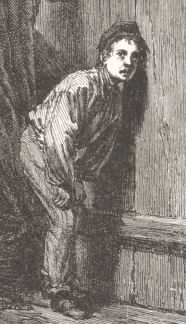
The boy heard someone speaking in the hold.
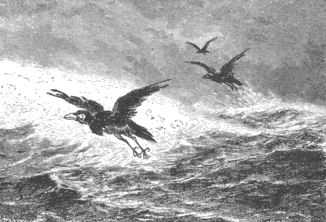
All at once, as he sat forward in the forecastle, he heard someone speaking in the hold. He peeped through a crevice and saw three coal-black ravens sitting on a cross beam and talking about their husbands, whom they were all tired of and whom they wished at the bottom of the sea. It was easy to understand that they were witches who had turned themselves into ravens.
"But are you sure that nobody hears us?" asked one of the ravens. The boy knew by the voice that it was the skipper's wife.
"No of course not," said the other two, who were the wives of the first and second mates, "there is none on board."
"Well, then I'll tell you; I know a good way to get rid of them," said the skipper's wife, and jumped closer to the other two; "we'll make ourselves into three heavy seas, and strike the vessel and sink it with all hands."
The other ravens thought that was the great way of doing it. Now they remained some time and talked about the time and place.
"But I suppose no one hears us?" said the skipper's wire again.
"Well, you know that," answered the other two.
"You see, there is a remedy they could use against us which, if it were used, would be a serious thing for us and would cost our lives."
"What is that, sister," said one of the mates' wives.
"But are you sure that no one hears us? I thought I saw some smoke from the forecastle."
"You know there isn't anyone! We've looked into every corner. They forgot to put out the fire in the stove, that's the reason it smokes," said the mates' wives. "Tell about the remedy!"
"If they buy three cords of birch logs," said the witch, "- but they must be exact measure and there is to be no bargaining about the price - and if they throw overboard the one cord of logs, piece by piece, when the first sea comes, and the second cord, piece by piece, when the second sea comes, and the third cord, piece by piece, when the third sea comes, then it's all over with us."
"Yes, that's true, sister, then it's all over with us, then it's all over with us!" said the mates' wives; "but nobody knows it." They screeched and laughed aloud, and then they flew up through the main hatch, and screeched and gobbled like ravens.
Norwegian folktales illustration.
Three ravens.
When they were ready to sail, the lad would not for the life of him go on the ship for all the skipper talked to him and promised him. There was no help for it, he would on no account go in the ship. At last they asked him if he was afraid, since it was getting so late in the autumn. Maybe he would rather sit in the chimney-corner behind his mother's petticoats?
"No," said the lad, he was not afraid; he thought they never had seen any sign of his being afraid, or using tricks as the land crabs might do. He would prove it to them, for now he would go with them in the ship, but on the condition that they bought three cords of birch logs, exactly measured, and that he was to have the command of the ship, as if he was the skipper, on a certain day.
The skipper asked the meaning of this, and if he had ever heard of a boy taking the command of a vessel?
The lad answered that it was much the same to him, but if they wouldn't buy three cords of birch logs, and obey him, as if he was the captain for one day only - and he would tell them what day beforehand - he wouldn't set his foot on board any more. Still less would he dirty his hands in pitch and tar on board that ship. That's what he said.
The skipper thought it was a very strange idea, and that he was a strange lad altogether, but he agreed at last, because he had set his heart on having the boy with him, and I suppose he thought he could easily manage him when they got out to sea.
The mate was of the same opinion. "Oh! never mind! Let him take the command! If we go to seaward we'll have to give him a hand!" said the mate.
So the birch logs were bought and correctly measured, and no bargaining was made about the price, and then they sailed.
When the day arrived that the boy was to be skipper, the weather was calm and fine, but he called all men to reef sails, so the ship had scarcely any sail on her. It was just about the time when the middle watch was over and the morning watch was called. Both skipper and crew smiled and said:
"It's easy to see who has command of the ship now; why not full the sails altogether?"
"Not yet," said the lad, "but very shortly."
Suddenly a squall burst on them, so violent that they thought the ship would have capsized. If they had not reefed the sails there was no doubt they would have foundered when the first squall struck the ship.
The lad now ordered them to throw out the first cord of birch logs, but piece by piece, only one at a time, never two, and they must not touch the other two cords of wood.
"The crew was smart in carrying out his orders now, and they did not laugh any more at him, but threw the birch logs overboard, piece by piece. When the last piece went over the side they heard a moaning as from one who is in the last pangs of death, and the next moment the squall was over.
"The Lord be praised!" said the crew.
"Well, I must say that you have saved both ship and cargo, and I'll report it to the owners - and stand by it," said the skipper.
"Oh yes, that's all very well, but we haven't done with it yet," said the lad, "we'll have it worse directly," and he ordered them to furl every sail but the mizen.
The second squall came still stronger than the first, and the crew were in a great fright. Just as it was blowing at its hardest the lad told them to throw the other cord of logs overboard. They did; they threw piece by piece, and took good care not to touch the third cord. When the last log went over the side they heard a deep groaning and wind went down.
"We have one bout left now, and that will be the worst," said the boy, and ordered every man to his post, while the ship only went under bare poles.
The last squall was worse than both the forerunners; the ship gave a lurch and they thought it would never right itself again. The seas washed over deck and gunwale. But the lad ordered them to throw overboard the last cord of logs, piece by piece, not two at a time. When the last log went over the side they heard the moaning of one who dies a hard death. When the wind had gone down, the sea was red as blood as far as they could see.
When all was over the captain and the mates said they would write to their wives.
"You may as well leave that alone," said the lad. "You haven't got any wives any more!"
"What nonsense is that, you young whelp? No wives?" said the captain.
"Have you finished them off, perhaps?" said the first mate.
"Oh dear, we've all had a hand in that," answered the boy. Then he told them what he had heard and seen the Sunday he was on board keeping watch, when the crew had liberty ashore, and the skipper went to see the timber-dealer.
When they came home they heard that their wives had disappeared the day before the storm. They had never been seen or heard of since.
Enhanced by Zemanta

Saturday, July 10, 2010

Why the Sea Is Salt

ONCE ON A TIME, but it was a long, long time ago, there were two brothers, one rich and one poor. Now, one Christmas eve, the poor one hadn't so much as a crumb in the house, either of meat or bread, so he went to his brother to ask him for something to keep Christmas with, in God's name. It was not the first time his brother had been forced to help him, and you may fancy he wasn't very glad to see his face, but he said:
"If you will do what I ask you to do, I'll give you a whole flitch of bacon."
So the poor brother said he would do anything, and was full of thanks.
"Well, here is the flitch," said the rich brother, "and now go straight to hell."
"What I have given my word to do, I must stick to," said the other; so he took the flitch and set off. He walked the whole day, and at dusk he came to a place where he saw a very bright light.
"Maybe this is the place," said the man to himself. So he turned aside, and the first thing he saw was an old, old man, with a long white beard, who stood in an outhouse, hewing wood for the Christmas fire.
"Good evening," said the man with the flitch.
"The same to you; where are you going so late?" said the man.
"Oh! I'm going to hell, if I only knew the right way," answered the poor man.
"Well, you're not far wrong, for this is hell," said the old man; "when you get inside they will be all for buying your flitch, for meat is scarce in hell; but mind, you don't sell it unless you get the hand-quern which stands behind the door for it. When you come out, I'll teach you how to handle the quern, for it's good to grind almost anything."
So the man with the flitch thanked the other for his good advice, and gave a great knock at the devil's door.
When he got in, everything went just as the old man had said. All the devils, great and small, came swarming up to him like ants round an anthill, and each tried to outbid the other for the flitch.
"Well!" said the man, "by rights my old dame and I ought to have this flitch for our Christmas dinner; but since you have all set your hearts on it, I suppose I must give it up to you; but if I sell it at all, I'll have for it that quern behind the door yonder."
At first the devil wouldn't hear of such a bargain, and chaffered and haggled with the man; but he stuck to what he said, and at last the devil had to part with his quern. When the man got out into the yard, he asked the old woodcutter how he was to handle the quern; and after he had learned how to use it, he thanked the old man and went off home as fast as he could, but still the clock had struck twelve on Christmas eve before he reached his own door.
"Wherever in the world have you been?" said his old dame; "here have I sat hour after hour waiting and watching, without so much as two sticks to lay together under the Christmas brose."
"Oh!" said the man, "I couldn't get back before, for I had to go a long way first for one thing, and then for another; but now you shall see what you shall see."
So he put the quern on the table, and bade it first of all grind lights, then a table-cloth, then meat, then ale, and so on till they had got everything that was nice for Christmas fare. He had only to speak the word, and the quern ground out what he wanted. The old dame stood by blessing her stars and kept on asking where he had got this wonderful quern, but he wouldn't tell her.
"It's all one where I got it from; you see the quern is a good one, and the mill-stream never freezes, that's enough."
So he ground meat and drink and dainties enough to last out till Twelfth Day, and on the third day he asked all his friends and kin to his house, and gave a great feast. Now, when his rich brother saw all that was on the table, and all that was behind in the larder, he grew quite spiteful and wild, for he couldn't bear that his brother should have anything.
"It was only on Christmas eve," he said to the rest, "he was in such straits that he came and asked for a morsel of food in God's name, and now he gives a feast as if he were count or king;" and he turned to his brother and said:
"But from where, in hell's name, have you got all this wealth?"
"From behind the door," answered the owner of the quern, for he didn't care to let the cat out of the bag. But later on the evening, when he had got a drop too much, he could keep his secret no longer, and brought out the quern and said:
"There, you see what has gotten me all this wealth;" and so he made the quern grind all kind of things. When his brother saw it, he set his heart on having the quern, and, after a deal of coaxing, he got it; but he had to pay three hundred dollars for it, and his brother bargained to keep it till hay-harvest, for he thought, if I keep it till then, I can make it grind meat and drink that will last for years. So you may fancy the quern didn't grow rusty for want of work, and when hay-harvest came, the rich brother got it, but the other took care not to teach him how to handle it.
It was evening when the rich brother got the quern home, and next morning he told his wife to go out into the hay-field and toss, while the mowers cut the grass, and he would stay at home and get the dinner ready. So, when dinner-time drew near, he put the quern on the kitchen table and said:
"Grind herrings and broth, and grind them good and fast."
So the quern began to grind herrings and broth; first of all, all the dishes full, then all the tubs full, and so on till the kitchen floor was quite covered. Then the man twisted and twirled at the quern to get it to stop, but for all his twisting and fingering the quern went on grinding, and in a little while the broth rose so high that the man was like to drown. So he threw open the kitchen door and ran into the parlour, but it wasn't long before the quern had ground the parlour full too, and it was only at the risk of his life that the man could get hold of the latch of the house door through the stream of broth. When he got the door open, he ran out and set off down the road, with the stream of herrings and broth at his heels, roaring like a waterfall over the whole farm.
Now, his old dame, who was in the field tossing hay, thought it a long time to dinner, and at last she said:
"Well! although the master doesn't call us home, we may as well go. Maybe he finds it hard work to boil the broth, and will be glad of my help."
The men were willing enough, so they sauntered homewards; but just as they had got a little way up the hill, what should they meet but herrings, and broth, and bread, all running and dashing, and splashing together in a stream, and the master himself running before them for his life, and as he passed them he bawled out,—"Would to heaven each of you had a hundred throats! But take care you're not drowned in the broth."
Away he went, as though the devil were at his heels, to his brother's house, and begged him for God's sake to take back the quern that instant; for, he said:
"If it grinds only one hour more, the whole parish will be swallowed up by herrings and broth."
But his brother wouldn't hear of taking it back till the other paid him down three hundred dollars more.
So the poor brother got both the money and the quern, and it wasn't long before he set up a farm-house far finer than the one in which his brother lived, and with the quern he ground so much gold that he covered it with plates of gold; and as the farm lay by the sea-side, the golden house gleamed and glistened far away over the sea. All who sailed by put ashore to see the rich man in the golden house, and to see the wonderful quern, the fame of which spread far and wide, till there was nobody who hadn't heard tell of it.
So one day there came a skipper who wanted to see the quern; and the first thing he asked was if it could grind salt.
"Grind salt!" said the owner; "I should just think it could. It can grind anything."
When the skipper heard that, he said he must have the quern, cost what it would; for if he only had it, he thought he should be rid of his long voyages across stormy seas for a lading of salt. Well, at first the man wouldn't hear of parting with the quern; but the skipper begged and prayed so hard, that at last he let him have it, but he had to pay many, many thousand dollars for it. Now, when the skipper had got the quern on his back, he soon made off with it, for he was afraid lest the man should change his mind; so he had no time to ask how to handle the quern, but got on board his ship as fast as he could, and set sail. When he had sailed a good way off, he brought the quern on deck and said:
"Grind salt, and grind both good and fast."
Well, the quern began to grind salt so that it poured out like water; and when the skipper had got the ship full, he wished to stop the quern, but whichever way he turned it, and however much he tried, it was no good; the quern kept grinding on, and the heap of salt grew higher and higher, and at last down sunk the ship.
There lies the quern at the bottom of the sea, and grinds away at this very day, and that's why the sea is salt.
Enhanced by Zemanta

Friday, July 9, 2010

Two Step-Sisters

ONCE there was a couple, and each of them had a daughter by a former marriage. The woman's daughter was dull and lazy, and could never turn her hand to anything, and the man's daughter was brisk and ready; but somehow or other she could never do anything to her stepmother's liking, and both the woman and her daughter would have been glad to be rid of her.
So it fell one day the two girls were to go out and spin by the side of the well, and the woman's daughter had flax to spin, but the man's daughter got nothing to spin but bristles. "I don't know how it is," said the woman's daughter, "you're always so quick and sharp, but still I'm not afraid to spin a match with you."
So they span away; but just as they were hard at it, the man's daughter's thread broke, and she had to go down the well. When she got to the bottom, she saw far and wide around her a fair green mead, and she had not hurt herself at all.
So she walked on a bit, till she came to a hedge which she had to cross.
"Ah! don't tread hard on me, pray don't, and I'll help you another time, that I will," said the hedge.
Then the lassie made herself as light as she could, and trode so carefully she scarce touched a twig.
So she went on a bit farther, till she came to a brindled cow, which walked there with a milking-pail on her horns. It was a large pretty cow, and her udder was so full and round.
"Ah! be so good as to milk me, pray," said the cow; "I'm so full of milk. Drink as much as you please, and throw the rest over my hoofs, and see if I don't help you some day."
So the man's daughter did as the cow begged. As soon as she touched the teats, the milk spouted out into the pail. Then she drank till her thirst was slaked; and the rest she threw over the cow's hoofs, and the milking pail she hung on her horns again.
So when she had gone a bit farther, a big wether met her, which had such thick long wool, it hung down and draggled after him on the ground, and on one of his horns hung a great pair of shears.
"Ah! please clip off my wool," said the sheep, "for here I go about with all this wool, and catch up everything I meet, and besides, it's so warm, I'm almost choked. Take as much of the fleece as you please, and twist the rest round my neck, and see if I don't help you some day."
Yes; she was willing enough, and the sheep lay down of himself on her lap, and kept quite still, and she clipped him so neatly, there wasn't a scratch on his skin. Then she took as much of the wool as she chose, and the rest she twisted round the neck of the sheep.
A little farther on, she came to an apple-tree, which was loaded with apples; all its branches were bowed to the ground, and leaning against the stem was a slender pole.
"Ah! do be so good as to pluck my apples off me," said the Tree, "so that my branches may straighten themselves again, for it's bad work to stand so crooked; but when you beat them down, don't strike me too hard. Then eat as many as you please, lay the rest round my root, and see if I don't help you some day or other."
Yes; she plucked all she could reach with her hands, and then she took the pole and knocked down the rest, and afterwards she ate her fill, and the rest she laid neatly round the root.
So she walked on a long, long way, and then she came to a great farm-house, where an old hag of the Trolls lived with her daughter. There she turned in to ask if she could get a place.
"Oh!" said the old hag; "it's no use your trying. We've had ever so many maids, but none of them was worth her salt."
But she begged so prettily that they would just take her on trial, that at last they let her stay. So the old hag gave her a sieve, and bade her go and fetch water in it. She thought it strange to fetch water in a sieve, but still she went, and when see came to the well, the little birds began to sing:
Daub in clay,
Stuff in straw;
Daub in clay,
Stuff in straw.
Yes, she did so, and found she could carry water in a sieve well enough; but when she got home with the water, and the old witch saw the sieve, she cried out:
"You haven't sucked this out of your own breast."
So the old witch said, now she might go into the byre to pitch out dung and milk kine; but when she got there she found a pitchfork so long and heavy she couldn't stir it, much less work with it. She didn't know at all what to do, or what to make of it; but the little birds sang again that she should take the broomstick and toss out a little with that, and all the rest of the dung would fly after it. So she did that, and as soon as ever she began with the broomstick, the byre was as clean as if it had been swept and washed.
Now she had to milk the kine, but they were so restless that they kicked and frisked; there was no getting near them to milk them.
But the little birds sang outside:
A little drop, a tiny sup,
For the little birds to drink it up.
Yes, she did that; she just milked a tiny drop, it was as much as she could, for the little birds outside; and then all the cows stood still and let her milk them. They neither kicked nor frisked; they didn't even lift a leg.
So when the old witch saw her coming in with the milk, she cried out:
"This you haven't sucked out of your own breast. But now just take this black wool and wash it white."
This the lassie was at her wit's end to know how to do, for she had never seen or heard of any one who could wash black wool white. Still she said nothing, but took the wool and went down with it to the well. There the little birds sang again, and told her to take the wool and dip it into the great butt that stood there; and she did so, and out it came as white as snow.
"Well, I never!" said the old witch, when she came in with the wool, "it's no good keeping you. You can do everything, and at last you'll be the plague of my life. We'd best part, so take your wages and be off."
Then the old hag drew out three caskets, one red, one green, and one blue, and of these the lassie was to choose one as wages for her service. Now she didn't know at all which to choose, but the little birds sang:
Don't take the red, don't take the green,
But take the blue, where may be seen
Three little crosses all in a row;
We saw the marks, and so we know.
So she took the blue casket, as the birds sang.
"Bad luck to you, then," said the old witch; "see if I don't make you pay for this!"
So when the man's daughter was just setting off, the old witch shot a red-hot bar of iron after her, but she sprang behind the door and hid herself, so that it missed her, for her friends, the little birds, had told her beforehand how to behave. Then she walked on and on as fast as ever she could; but when she got to the apple-tree, she heard an awful clatter behind her on the road, and that was the old witch and her daughter coming after her.
The lassie was so frightened and scared, she didn't know what to do.
"Come here to me, lassie, do you hear," said the apple-tree, "I'll help you; get under my branches and hide, for if they catch you they'll tear you to death, and take the casket from you."
Yes; she did so, and she had hardly hidden herself before up came the old witch and her daughter.
"Have you seen any lassie pass this way, you apple-tree?" said the old hag.
The apple-tree kept silent. So the old witch turned back and went home again.
Then the lassie walked on a bit, but when she came just about where the sheep was, she heard an awful clatter beginning on the road behind her, and she didn't know what to do, she was so scared and frightened; for she knew well enough it was the old witch, who had thought better of it.
"Come here to me, lassie," said the wether, "and I'll help you. Hide yourself under my fleece, and then they'll not see you; else they'll take away the casket, and tear you to death."
Just then up came the old witch, tearing along.
"Have you seen any lassie pass here, you sheep?" she cried to the wether.
The wether said baah, baah to her, and the old witch could not make out what it meant, so she turned round and went home.
But when the lassie had come to where she met the cow, she heard another awful clatter behind her.
"Come here to me, lassie," said the cow, "and I'll help you to hide yourself under my udder, else the old hag will come and take away your casket, and tear you to death."
True enough, it wasn't long before she came up.
"Have you seen any lassie pass here, you cow?" said the old hag.
"Moo, moo," said the cow, and the hag could not understand what to make out of it. So she turned round, and went back home again.
When the lassie had walked a long, long way farther on, and was not far from the hedge, she heard again that awful clatter on the road behind her, and she got scared and frightened, for she knew well enough it was the old hag and her daughter, who had changed their minds.
"Come here to me, lassie," said the hedge, "and I'll help you. Creep under my twigs, so that they can't see you; else they'll take the casket from you, and tear you to death."
Yes; she made all the haste she could to get under the twigs of the hedge.
"Have you seen any lassie pass this way, you hedge?" said the old hag to the hedge.
"Talking to a hedge, a hedge?" whispered the hedge thoughtfully, and all the while he spread himself out and made himself so big and tall that one had to think twice before crossing him. And so the old witch had no help for it but to turn round and go home again.
When the man's daughter got home, her step-mother and her step-sister were more spiteful against her than ever; for now she was much neater, and so smart that it was a joy to look at her. Still she could not get leave to live with them; they drove her out into a pig-sty. That was to be her house.
Inside, she opened her casket, just to see what she had got for her wages. But as soon as she unlocked it, she saw inside so much gold and silver, and lovely things, which came streaming out till all the walls were hung with them, and at last the pig-sty was far grander than the grandest king's palace.
When the step-mother and her daughter came to see this, they almost jumped out of their skin, and began to ask what kind of a place she had down there?
"Oh," said the lassie, "I got such good wages. It was such a family and such a mistress to serve, you couldn't find their like anywhere."
The woman's daughter made up her mind to go out to serve too, that she might get just such another gold casket. So they sat down to spin again, and now the woman's daughter was to spin bristles, and the man's daughter flax, and she whose thread first snapped was to go down the well.
It wasn't long, as you may fancy, before the woman's daughter's thread snapped, and so they threw her down the well.
So the same thing happened. She fell to the bottom, but met with no harm, and found herself on a lovely green meadow. When she had walked a bit she came to the hedge.
"Don't tread hard on me, pray, lassie, and I'll help you again," said the hedge.
"Oh!" said she, "what should I care for a bundle of twigs!" and tramped and stamped over the hedge till it cracked and groaned again.
A little farther on she came to the cow, which walked about ready to burst for want of milking.
"Be so good as to milk me, lassie," said the cow, "and I'll help you again. Drink as much as you please, but throw the rest over my hoofs."
Yes, she did that; she milked the cow, and drank till she could drink no more; but when she left off, there was none left to throw over the cow's hoofs, and as for the pail, she tossed it down the hill and walked on.
When she had gone a bit farther, she came to the sheep, which walked along with his wool dragging after him.
"Oh, be so good as to clip me, lassie," said the sheep, "and I'll serve you again. Take as much of the wool as you will, but twist the rest round my neck."
Well, she did that; but she went so carelessly to work, that she cut great pieces out of the poor sheep, and as for the wool, she carried it all away with her.
A little while after she came to the apple-tree, which stood there quite crooked with fruit again.
"Be so good as to pluck the apples off me that my limbs may grow straight, for it's weary work to stand all awry," said the apple-tree. "But please take care not to beat me too hard. Eat as many as you will, but lay the rest neatly round my root, and I'll help you again."
Well, she plucked those nearest to her, and thrashed down those she couldn't reach with the pole; but she didn't care how she did it, and broke off and tore down great boughs, and ate till she was as full as full as could be, and then she threw down the rest under the tree.
When she had gone a good bit farther, she came to the farm where the old witch lived. There she asked for a place, but the old hag said she wouldn't have any more maids, for they were either worth nothing, or were too clever and cheated her out of her goods. But the woman's daughter was not to be put off, she woul have a place, so the old witch said she would give her a trial, if she was fit for anything.
The first thing she had to do was to fetch water in a sieve. Well, off she went to the well, and drew water in a sieve, but as fast as she got it in it ran out again. So the little birds sang,
Daub in clay,
Put in straw
Daub in clay, Put in straw."
But she didn't care to listen to the birds' song, and pelted them with clay till they flew off far away. And so she had to go home with the empty sieve, and got well scolded by the old witch.
Then she was to go into the byre to clean it, and milk the kine. But she was too good for such dirty work, she thought. Still, she went out into the byre, but when she got there, she could not get on at all with the pitchfork, it was so big. The birds said the same to her as they had said to her step-sister, and told her to take the broomstick, and toss out a little dung, and then all the rest would fly after it; but all she did with the broomstick was to throw it at the birds.
When she came to milk, the kine were so unruly, they kicked and pushed, and every time she got a little milk in the pail, over they kicked it. Then the birds sang again:
A little drop, and a tiny sup,
For the little birds to drink it up.
But she beat and banged the cows about, and threw and pelted at the birds everything she could lay hold of, and made such a to do, it was awful to see. So she did not make much either of her pitching or milking.
When she came indoors she got blows as well as hard words from the old witch, who sent her off to wash the black wool white; but that, too, she did no better.
Then the old witch thought this really too bad, so she set out the three caskets, one red, one green, and one blue, and said she'd no longer any need of her services. For wages she should have leave to choose whichever casket she pleased.
Then sang the little birds:
Don't take the red, don't take the green,
But choose the blue, where may be seen
Three little crosses all in a row;
We saw the marks, and so we know.
She didn't care a pin for what the birds sang, but took the red, which caught her eye most. And so she set out on her road home, and she went along quietly and easily enough; there was no one who came after her.
When she got home, her mother was ready to jump with joy, and the two went at once into the ingle, and put the casket up there, for they made up their minds there could be nothing in it but pure silver and gold, and they thought to have all the walls and roof gilded like the pig-sty. But when they opened the casket there came tumbling out nothing but toads, and frogs, and snakes; and worse than that, whenever the woman's daughter opened her mouth, out popped a toad or a snake, so that at last there was no living in the house with her.
That was all the wages she got for being unable to behave herself when trying to gain from serving an old witch.

Thursday, July 8, 2010

The Cat on the Dovrefjell

ONCE ON A TIME there was a man up in Finnmark who had caught a great white bear, which he was going to take to the king of Denmark. Now, it so fell out that he came to the Dovre mountain plateau just about Christmas Eve, and there he turned into a cottage where a man lived, whose name was Halvor, and asked the man if he could get house-room there for his bear and himself.
"Heaven never help me, if what I say isn't true!" said the man; "but we can't give any one house-room just now, for every Christmas Eve such a pack of trolls come down on us that we are forced to flit, and haven't so much as a house over our own heads, to say nothing of lending one to any one else."
"Oh!" said the man, "if that's all, you can very well lend me your house; my bear can lie under the stove over there, and I can sleep in the side-room."
Well, he begged so hard, that at last he got leave to stay there; so the people of the house flitted out, and before they went everything was got ready for the trolls; the tables were laid, and there was rice porridge, and fish boiled in lye, and sausages, and all else that was good, just as for any other grand feast.
So, when everything was ready, down came the trolls. Some were great, and some were small; some had long tails, and some had no tails at all; some, too, had long, long noses; and they ate and drank, and tasted everything. Just then one of the little trolls caught sight of the white bear, who lay under the stove; so he took a piece of sausage and stuck it on a fork, and went and poked it up against the bear's nose, screaming out:
"Pussy, will you have some sausage?"
Then the white bear rose up and growled, and hunted the whole pack of them out of doors, both great and small.
Next year Halvor was out in the wood on the afternoon of Christmas Eve, cutting wood before the holidays, for he thought the trolls would come again; and just as he was hard at work, he heard a voice in the wood calling out:
"Halvor! Halvor!"
"Well," said Halvor, "here I am."
"Have you got your big cat with you still?"
"Yes, that I have," said Halvor; "she's lying at home under the stove, and what's more, she has now got seven kittens, far bigger and fiercer than she is herself."
"Oh, then, we'll never come to see you again," bawled out the troll away in the wood, and he kept his word; for since that time the trolls have never eaten their Christmas brose with Halvor on the Dovrefjell.

Wednesday, July 7, 2010

Thumbikin

THERE WAS A WOMAN gambler who had an only son, and he was no taller than your thumb; and so they called him Thumbikin.
When he had come to be old enough to know right and wrong, his mother told him to go out and woo him a bride, for now she said it was high time he thought about getting a wife. When Thumbikin heard that, he was very glad; so they got their driving gear in order and set off, and his mother put him into her bosom. Now they were going to a palace where there was such an awfully big princess, but when they had gone a bit of the way, Thumbikin was lost and gone. His mother hunted for him everywhere, and bawled to him, and wept because he was lost, and she couldn't find him again.
"Huzzah, whee," said Thumbikin, "here I am, "and he had hidden himself in the horse's mane.
So he came out, and had to give his word to his mother that he wouldn't do so any more. But when they had driven a bit farther on, Thumbikin was lost again. His mother hunted for him, and called him and wept; but gone he was, and gone he stayed.
"Huzzah, whee," said Thumbikin at last; and then she heard how he laughed and tittered, but she couldn't find him at all for the life of her.
"Huzzah, whee, why, here I am now!" said Thumbikin, and came out of the horse's ear.
So he had to give his word that he wouldn't hide himself again; but they had hardly driven a bit farther before he was gone again. He couldn't help it. As for his mother, she hunted, and wept, and called him by name; but gone he was, and gone he stayed; and the more she hunted, the less she could find him in any way.
"Huzzah, whee, here I am then," said Thumbikin.
But she couldn't make out at all where he was, his voice sounded so dull and muffled.
So she hunted, and he kept on saying, "Huzzah, whee, here I am," and laughed and chuckled, that she couldn't find him; but all at once the horse snorted, and it snorted Thumbikin out, for he had crept up one of his nostrils.
Then his mother took him and put him into a bag; she knew no other way, for she saw well enough he couldn't help hiding himself.
So when they came to the palace the match was soon made, for the princess thought him a pretty little chap, and it wasn't long before the wedding came on too.
Now, when they were going to sit down to the wedding feast, Thumbikin sat at the table by the princess's side; but he had worse than no seat, for when he was to eat he couldn't reach up to the table; and so, if the princess hadn't helped him up on to it, he wouldn't have got a bit to eat.
Now it went good and well so long as he had to eat off a plate, but then there came a great bowl of porridge - that he couldn't reach up to; but Thumbikin soon found out a way to help himself; he climbed up and sat on the lip of the bowl But then there was a pat of melting butter right in the middle of the bowl, and that he couldn't reach to dip his porridge into it, and so he went on and took his seat at the edge of the melting butter; but just then who should come but the princess, with a great spoonful of porridge to dip it into the butter; and, alas! she went too near to Thumbikin, and tipped him over; and so he fell over head and ears, and was drowned in the melted butter.
Enhanced by Zemanta

Tuesday, July 6, 2010

The Master-Smith

IN THE DAYS when Our Lord and St. Peter used to wander on earth, they came to a smith's house. He had made a bargain with the devil that the fiend should have him after seven years, but during that time he was to be the master of all masters in his trade, and to this bargain both he and the devil had signed their names. So he had stuck up in great letters over the door of his forge,
"Here is the master over all masters."
Now when the Lord passed by and saw that, he went in.
"Who are you?" he said to the smith.
"Read what's written over the door," said the smith; "but maybe you can't read writing. If so, you must wait till someone comes to help you."
Before the Lord had time to answer him, a man came with his horse, which he begged the smith to shoe.
"Might I have leave to shoe it?" asked the Lord.
"You may try, if you like," said the smith; "you can't do it so badly that I shall not be able to make it right again."
So the Lord went out and took one leg off the horse, and laid it in the furnace, and made the shoe red-hot; after that he turned up the ends of the shoe, and filed down the heads of the nails, and clenched the points; and then he put back the leg safe and sound on the horse again. And when he was done with that leg, he took the other foreleg and did the same with it; and when he was done with that he took the hind-legs - first the off, and then the near leg, and laid them in the furnace, making the shoes red-hot, turning up the ends, filing the heads of the nails, and clenching the points; and after all was done, putting the legs on the horse again. All the while the smith stood by and looked on.
"You're not so bad a smith after all," said he.
"Oh, you think so, do you?" said the Lord.
A little while after came the smith's mother to the forge, and called him to come home and eat his dinner; she was an old, old woman, with an ugly crook on her back, and wrinkles in her face, and it was as much as she could do to crawl along.
"Mark now what you see," said the Lord.
Then he took the woman and laid her in the furnace, and smithied a lovely young maiden out of her.
"Well," said the smith, "I say now, as I said before, you are not such a bad smith after all. There it stands over my door - Here is the master over all masters; but for all that, I say right out, one learns as long as one lives;" and with that he walked off to his house and ate his dinner.
So after dinner, just after he had got back to his forge, a man came riding up to have his horse shod.
"It shall be done in the twinkling of an eye," said the smith, "for I have just learnt a new way to shoe; and a very good way it is when the days are short."
So he began to cut and hack till he had got all the horse's legs off, for he said, I don't know why one should go pottering backwards and forwards - first with one leg, and then with another.
Then he laid the legs in the furnace, just as he had seen the Lord lay them, and threw on a great heap of coal, and made his mates work the bellows bravely; but it went as one might suppose it would go. The legs were burnt to ashes, and the smith had to pay for the horse.
Well, he didn't care much about that, but just then an old beggar-woman came along the road, and he thought to himself, "Better luck next time;" so he took the old dame and laid her in the furnace, and though she begged and prayed hard for her life, it was no good.
"You're so old, you don't know what is good for you," said the smith; "now you shall be a lovely young maiden in half no time, and for all that, I'll not charge you a penny for the job."
But it went no better with the poor old woman than with the horse's legs.
"That was ill done, and I say it." said the Lord.
"Oh! for that matter," said the smith, "there's not many who'll ask after her, I'll be bound; but it's a shame of the devil, if this is the way he holds to what is written up over the door."
"If you might have three wishes from me," said the first bigwig, "what would you wish for?"
"Only try me," said the smith, "and you'll soon know."
So the Lord gave him three wishes.
"Well," said the smith, "first and foremost, I wish that any one whom I ask to climb up into the pear-tree that stands outside by the wall of my forge, is to stay sitting there till I ask him to come down again. The second wish I wish is, that any one whom I ask to sit down in my easy chair which stands inside the workshop yonder, has to stay sitting there till I ask him to get up. Last of all, I wish that any one whom I ask to creep into the steel purse which I have in my pocket, has to stay in it till I give him leave to creep out again."
"You have wished as a wicked man," said St. Peter; "first and foremost, you should have wished for Snout's grace and good will."
"I hardly aim as high as that," said the smith; and after that the Lord and holy Peter bade him " good-bye," and went on their way.
Well, the years went on and on, and when the time was up, the devil came to fetch the smith, as it was written in their bargain.
"Are you ready?" he said, as he stuck his nose in at the door of the forge.
"Oh," said the smith, "I must just hammer the head of this ten-penny nail first; meantime you can just climb up into the pear-tree, and pluck yourself a pear to gnaw at; you must be both hungry and thirsty after your journey."
So the devil thanked him for his kind offer, and climbed up into the pear-tree.
"Very good," said the smith; "but now, on thinking the matter over, I find I shall never be able to have done hammering the head of this nail till four years are out at least, this iron is so plague hard; down you can't come in all that time, but may sit up there and rest your bones."
When the devil heard this, he begged and prayed till his voice was as thin as a silver penny that he might have leave to come down; but there was no help for it. There he was, and there he must stay. At last he had to give his word of honour not to come again till the four years were out, which the smith had spoken of, and then the smith said, "Very well, now you can come down."
So when the time was up, the devil came again to fetch the smith.
"You're ready now, of course," said he; "you've had time enough to hammer the head of that nail, I should think."
"Yes, the head is right enough now," said the smith; "but still you have come a little tiny bit too soon, for I haven't quite done sharpening the point; such troublesome, hard iron I never hammered in all my born days. So while I work at the point, you may just as well sit down in my easy chair and rest yourself; I'll be bound you're weary after coming so far."
"Thank you kindly," said the devil, and down he plumped into the easy chair; but just as he had made himself comfortable, the smith said, on second thoughts found he couldn't get the point sharp till four years were out. First of all, the devil begged so prettily to be let out of the chair, and afterwards, waxing wroth, he began to threaten and scold; but the smith kept on, all the while excusing himself, and saying it was all the iron's fault, it was annoyingly hard, and telling the devil he was not so badly off to have to sit quietly in an easy-chair, and that he would let him out to the minute when the four years were over. Well, at last there was no help for it, and the devil had to give his word of honour not to fetch the smith till the four years were out; and then the smith said,
"Well now, you may get up and be off about your business," and away went the devil as fast as he could lay legs to the ground.
When the four years were over the devil came again to fetch the smith, and he called out, as he stuck his nose in at the door of the forge,
"Now, I know you must be ready."
"Ready, aye, ready," answered the smith; "we can go now as soon as you please; but there is one thing I have stood here and thought, and thought, I would ask you to tell me. Is it true what people say, that the devil can make himself as small as he pleases?"
"Snout knows, it is the very truth," said the devil.
"Oh!" said the smith; "it's true, is it? Then I wish you would just be so good as to creep into this steel purse of mine, and see whether it is sound at the bottom, for, to tell you the truth, I'm afraid my travelling money will drop out."
"With all my heart," said the devil, who made himself small in a thrice, and crept into the purse; but he was hardly in when the smith snapped to the clasp.
"Yes," called out the devil inside the purse; "it's right and tight everywhere."
"Very good," said the smith; "I'm glad to hear you say so, but "More haste the worse speed," says the old saw, and "Forewarned is forearmed," says another; so I'll just weld these links a little together, just for safety's sake." With that wisdom he laid the purse in the furnace, and made it red hot.
"Ouch! Ouch!" screamed the devil, "are you mad? don't you know I'm inside the purse?"
"Yes, I do!" said the smith; "but I can't help you, for another old saw says, "One must strike while the iron is hot;" and as he said this, he took up his sledge-hammer, laid the pulse on the anvil, and let fly at it as hard as he could.
"Ouch! Ouch! Ouch!" bellowed the devil, inside the purse. "Dear friend, do let me out, and I'll never come near you again."
"Very well!" said the smith; "now, I think, the links are pretty well welded, and you may come out;" so he unclasped the purse, and away went the devil in such a hurry that he didn't once look behind him.
Now, some time after, it came across the smith's mind that he had done a silly thing in making the devil his enemy, for he said to himself,
"If, as is like enough, they won't have me in the realm of lordship, I shall be in danger of being homeless, since I've fallen out with him who rules over Hades."
So he made up his mind it would be best to try to get either into Hades or Poker, and to try at once, rather than to put it off any longer, so that he might know how things really stood. Then he threw his sledge-hammer over his shoulder and set off; and when he had gone a good bit of the way, he came to a place where two roads met, and where the path to the realm of lordship parts from the path that leads to Hades, and here he overtook a tailor, who was pelting along with his goose in his hand.
"Good day," said the smith; "where are you off to?"
"To the realm of lordship," said the Tailor, "if I can only get into it; - but where are you going yourself?"
"Oh, our ways don't run together," said the smith; "for I have made up my mind to try first in Hades, as the devil and I know something of one another from old times."
So they bade one another "Good-bye," and each went his way; but the smith was a stout strong man, and got over the ground far faster than the tailor, and so it wasn't long before he stood at the gates of Hades. Then he called the watch, and bade him go and tell the devil there was someone outside who wished to speak a word with him.
"Go out," said the devil to the watch, "and ask him who he is?" So that when the watch came and told him that, the smith answered,
"Go and greet the devil in my name, and say it is the smith who owns the purse he knows of; and beg him prettily to let me in at once, for I worked at my forge till noon, and I have had a long walk since."
But when the devil heard who it was he charged the watch to go back and lock up all the nine locks on the gates of Hades.
"And, besides," he said, "you may as well put on a padlock, for if he only once gets in, he'll turn Hades topsy-turvy!"
"Well!" said the smith to himself, when he saw them busy bolting up the gates, "there's no lodging to be got here, that's plain; so I may as well try my luck in the realm of lordship;" and with that he turned round and went back till he reached the cross-roads, and then he went along the path the tailor had taken. And now, as he was cross at having gone backwards and forwards so far for no good, he strode along with all his might, and reached the, gate of Poker just as St. Peter was opening it a very little, just enough to let the half-starved tailor slip in. The smith was still six or seven strides off the gate, so he thought to himself, "Now there's no time to be lost;" and grasping his sledge-hammer, he hurled it into the opening of the door just as the tailor slunk in; and if the smith didn't get in then, when the door was ajar, why I don't know what has become of him.

Monday, July 5, 2010

Big Bird Dam

THERE WAS A KING who had twelve daughters, and he was so fond of them they must always be at his side; but every day at noon, while the king slept, the princesses went out to take a walk. So once, while the king was taking his noontide nap, and the princesses had gone to take their walk, all at once they were missing, and worse, they never came home again. Then there was great grief and sorrow all over the land but the most sorry of all was the king. He sent messengers out throughout his own and other realms, and gave out their names in all the churches, and had the bells tolled for them in all the steeples; but gone the princesses were, and gone they stayed, and none could tell what was become of them. So it was as clear as day that they must have been carried off by some witchcraft.
Well, it wasn't long before these tidings spread far and wide, over land and town, aye, over many lands; and so the news came to a king ever so many lands off, who had twelve sons. So when these princes heard of the twelve king's daughters, they asked leave of their father to go out and seek them. They had hard work to get his leave, for he was afraid lest he should never see them again, but they all fell down on their knees before the king, and begged so long, at last he was forced to let them go after all.
He fitted out a ship for them, and gave them Ritter Red, who was quite at home at sea, for a captain. So they sailed about a long, long time, landed on every shore they came to, and hunted and asked after the princesses, but they could neither hear nor see anything of them. And now, a few days only were wanting to make up seven years since they set sail, when one day a strong storm rose, and such foul weather, they thought they should never come to land again, and all had to work so hard, they couldn't get a wink of sleep so long as the storm lasted. But when the third day was nearly over, the wind fell, and all at once it got as still as still could be. Now, they were all so weary with work and the rough weather, they fell fast asleep in the twinkling of an eye; all but the youngest prince, he could get no rest, and couldn't go off to sleep at all.
So as he was pacing up and down the deck, the ship came to a little island, and on the island ran a little dog, and bayed and barked at the ship as if it wanted to come on board. So the prince went to that side of the deck, and tried to coax the dog, and whistled and whistled to him, but the more he whistled and coaxed, the more the dog barked and snarled. Well, he thought it a shame the dog should run about there and starve, for he made up his mind that it must have come thither from a ship that had been cast away in the storm; but still he thought he should never be able to help it after all, for he couldn't put out the boat by himself, and as for the others, they all slept so sound, he wouldn't wake them for the sake of a dog. But then the weather was so calm and still; and at last he said to himself; "Come what may, you must go on shore and save that dog," and so he began to try to launch the boat, and he found it far easier work than he thought. So he rowed ashore, and went up to the dog; but every time he tried to catch it, it jumped on one side, and so it went on till he found himself inside a great grand castle, before he knew where he was. Then the dog, all at once, was changed into a lovely princess; and there, on the bench, sat a man so big and ugly, the prince almost lost his wits for fear.
"YOU'VE NO NEED TO BE AFRAID," said the man - but the prince, to tell you the truth, got far more afraid when he heard his gruff voice - "for I know well enough what you want. There are twelve princes of you, and you are looking for the twelve princesses that are lost. I know, too, very well whereabouts they are; they're with my lord and master, and there they sit, each of them on her chair, and comb his hair; for he has twelve heads. And now you have sailed seven years, but you'll have to sail seven years more before you find them. As for you, you might stay here and welcome, and have my daughter; but you must first slay him, for he's a hard master to all of us, and we're all weary of him, and when he's dead I shall be king in his stead; but first try if you can brandish this sword."
Then the king's son took hold of a rusty old sword which hung on the wall, but he could hardly stir it.
"Now you must take a pull at this flask," said the troll; and when he had done that he could stir it, and when he had taken another he could lift it, and when he had taken a third he could brandish the sword as easily as if it had been his own.
"Now, when you get on board," said the troll prince, "you must hide the sword well in your berth, that Ritter Red mayn't set eyes on it; he's not man enough to wield it, but he'll get spiteful against you, and try to take your life. And when seven years are almost out all but three days," he went on to say, "everything will happen just as now; foul weather will come on you, with a great storm, and when it is over you'll all be sleepy. Then you must take the sword and row ashore, and so you'll come to a castle where all sorts of guards will stand - wolves, and bears, and lions; but you need not be afraid of them, for they'll all come and crouch at your feet. But when you come inside the castle, you'll soon see the troll; he sits in a splendid chamber in grand attire and array; twelve heads he has of his own, and the princesses sit round them, each on her chair, and comb his heads, and that's a work you can guess they don't much like. Then you must make haste, and hew off one head after the other as quick as you can; for if he wakes and sets his eyes on you, he'll swallow you alive."
So the king's son went on board with the sword, and he bore in mind what he had come to know. The others still lay fast asleep and snored, and he hid the sword in his berth, so that neither Ritter Red nor any of the rest got sight of it. And now it began to blow again, so he woke up the others, and said he thought they oughtn't to sleep any longer now when there was such a good wind. .and there was none of them that marked he had been away. Well, after the seven years were all gone but three days, all happened as the troll had said. A great storm and foul weather came on that lasted three days, and when it had blown itself out, all the rest grew sleepy and went to rest; but the youngest king's son rowed ashore, and the guards fell at his feet, and so he came to the castle. So when he got inside the chamber, there sat the king fast asleep as the troll prince had said, and the twelve princesses sat each on her chair and combed one of his heads. The king's son beckoned to the princesses to get out of the way; they pointed to the troll, and beckoned to him again to go his way as quick as ever he could, but he kept on making signs to them to get out of the way, and then they understood that he wanted to set them free, and stole away softly one after the other, and as fast as they went, he hewed off the troll king's heads, till at last the blood gushed out like a great brook. When the troll was slain he rowed on board and hid his sword. He thought now he had done enough, and as he couldn't get rid of the body by himself, he thought it only fair they should help him a little. So he woke them all up, and said it was a shame they should be snoring there, when he had found the princesses, and set them free from the troll. The others only laughed at him, and said he had been just as sound asleep as they, and only dreamt that he was man enough to do what he said; for if any one was to set the princesses free, it was far more likely it would be one of them. But the youngest king's son told them all about it, and when they followed him to the land and saw first of all the brook of blood, and then the castle, and the troll, and the twelve heads, and the princesses, they saw plain enough that he had spoken the truth, and now the whole helped him to throw the body and the heads into the sea. So all were glad and happy, but none more so than the princesses, who got rid of having to sit there and comb the troll's hair all day. Of all the silver and gold and precious things that were there, they took as much as the ship could hold, and so they went on board altogether princes and princesses alike.
But when they had gone a bit out on the sea, the princesses said they had forgotten in their joy their gold crowns, they lay behind in a press, and they would be so glad to have them. So when none of the others was willing to fetch them, the youngest king's son said,
"I have already dared so much, I can very well go back for the gold crowns too, if you will only strike sail and wait till I come again."
Yes, that they would do. But when he had gone back so far that they couldn't see him any longer, Ritter Red, who would have been glad enough to have been their chief, and to have the youngest princess, said, "it was no use their lying there still waiting for him, for they might know very well he would never come back; they all knew, too, how the king had given him all power and authority to sail or not as he chose; and now they must all say it was he that had saved the princesses, and if any one said anything else, he should lose his life."
The princes didn't dare to do anything else than what Ritter Red willed, and so they sailed away.
Meanwhile the youngest king's son rowed to land, went up to the castle, found the press with the gold crowns in it, and at last lugged it down to the boat, and shoved off; but when he came where he ought to have seen the ship, lo! it was gone. Well, as he couldn't catch a glimpse of it anywhere, he could very soon tell how matters stood. To row after them was no good, and so he was forced to turn about and row back to land. He was rather afraid to stay alone in the castle all night, but there was no other house to be got, so he plucked up a heart, locked up all the doors and gates fast, and lay down in a room where there was a bed ready made. But fearful and woeful he was, and still more afraid he got when he had lain a while and something began to creak and groan and quake in wall and roof, as if the whole castle were being torn asunder. Then all at once down something plunged close by the side of his bed, as if it were a whole cartload of hay. Then all was still again; but after a while he heard a voice, which bade him not to be afraid, and said,
"Here am I, the Big Bird Dam
Come to help you all I can."
"But the first thing you must do when you wake in the morning, will be to go to the barn and fetch four barrels of rye for me. I must fill my crop with them for breakfast, else I can't do anything."
When he woke up, sure enough there he saw an awfully big bird, which had a feather at the nape of his neck, as thick and long as a half-grown spruce fir. So the king's son went down to the barn to fetch four barrels of rye for the Big Bird Dam, and when he had crammed them into his crop he told the king's son to hang the press with the gold crowns on one side of his neck, and as much gold and silver as would weigh it down on the other side, and after that to get on his back and hold fast by the feather in the nape of his neck. So away they went till the wind whistled after them, and so it wasn't long before they outstripped the ship. The king's son wanted to go on board for his sword, for he was afraid lest any one should get sight of it, for the troll had told him that mustn't be; but Bird Dam said that mustn't be either.
"Ritter Red will never see it, never fear; but if you go on board, he'll try to take your life, for he has set his heart on having the youngest princess; but make your mind quite easy about her, for she lays a naked sword by her side in bed every night."
So after a long, long time, they came to the island where the troll prince was; and there the king's son was welcomed so heartily there was no end to it. The troll prince didn't know how to be good enough to him for having slain his Bigwig and Master, and so made him king of the trolls, and if the king's son had been willing he might easily have got the troll king's daughter, and half the kingdom. But he had so set his heart on the youngest of the twelve princesses, he could take no rest, but was all for going after their ship time after time. So the troll king begged him to be quiet a little longer, and said they had still nearly seven years to sail before they got home. As for the princess the troll said the same thing as the Big Bird Dam.
"You need not fret yourself about her, for she lays a naked sword by her side every night in bed. And now if you don't believe what I say," said the troll, "you can go on board when they sail by here, and see for yourself, and fetch the sword too for I may just as well have it again."
So when they sailed by another great storm arose, and when the king's son went on board they all slept, and each princess lay beside her prince; but the youngest lay alone with a naked sword beside her in the bed, and on the floor by the bedside lay Ritter Red. Then the king's son took the sword and rowed ashore again, and none of them had seen that he had been on board. But still the king's son couldn't rest, and he often and often wanted to be off, and so at last when it got near the end of the seven years, and only three weeks were left, the troll king said,
"Now you may get ready to go, since you won't stay with us; and you shall have the loan of my iron boat, which sails of itself, if you only say,
"Boat, boat, go on!"
In that boat there is an iron club, and that club you must lift a little when you see the ship straight a-head of you, and then they'll get such a rattling fair breeze, they'll forget to look at you. But when you get alongside them, you must lift the club a little again, and then they'll get such a foul wind and storm they'll have something else to do than to stare at you; and when you have run past them you must lift the club a third time, but you must always be sure and lay it down carefully again, else there'll be such a storm, both you and they will be wrecked and lost. Now when you have got to land, you have no need to bother yourself at all about the boat; just turn it about, and shove it off, and say,
"Boat, boat, go back home!""
When he set out they gave him so much gold and silver, and so many other costly things, and clothes and linen which the troll princess had sewn and woven for him all that long time, that he was far richer than any of his brothers.
Well, he had no sooner seated himself in the boat and said,
"Boat, boat, go on!"
than away went the boat, and when he saw the ship right a-head, he lifted up the club, and then they got such a fair breeze, they forgot to look at him. When he was alongside the ship, he lifted the club again, and then such a storm arose and such foul weather, that the white foam flew about the ship, and the billows rolled over the deck, and they had something else to do than to stare at him; and when he had run past them he lifted the club the third time, and then the storm and the wind rose so, they had still less time to look after him, and to make him out. So he came to land long, long before the ship; and when he had got all his goods out of the boat, he shoved it off again, and turned it about and said,
"Boat, boat, go back home!"
And off went the boat.
Then he dressed himself up as a sailor. - whether the troll king had told him that or it was his own device, I'm sure I can't say - and went up to a wretched hut where an old wife lived, whom he got to believe that he was a poor sailor who had been on board a great ship that was wrecked, and that he was the only soul that had got ashore. After that he begged for house-room for himself and the goods he had saved.
"Poverty mend me!" said the old wife, "how can I lend any one house-room! look at me and mine, why, I've no bed to sleep on myself, still less one for any one else to lie on."
Well, well, it was all the same, said the sailor; if he only got a roof over his head it didn't matter where he lay. So she couldn't turn him out of the house, when he was so thankful for what there was. That afternoon he fetched up his things, and the old wife, who was very eager to hear a bit of news to run about and tell, began at once to ask who he was, whence he came, where he was bound, what it was he had with him, what his business was, and if he hadn't heard anything of the twelve princesses who had been away the bigwig knew how many years. All this she asked and much more, which it would be waste of time to tell. But he said he was so poorly and had such a bad headache after the awful weather he had been out in, that he couldn't answer any of her questions; she must just leave him alone and let him rest a few days till he came to himself after the hard work he'd had in the gale, and then she'd know all she wanted.
The very next day the old wife began to stir him up and ask again, but the sailor's head was still so bad he hadn't got his wits together, but somehow he let drop a word or two to show that he did know something about the princesses. Off ran the old wife with what she had heard to all the gossips and chatterboxes round about, and soon the one came running after the other to ask about the princesses, "if he had seen them," "if they would soon be there," "if they were on the way," and much more of the same sort. He still went on groaning over his headache after the storm, so that he couldn't tell them all about it, but so much he told them, unless they had been lost in the great storm they'd make the land in about a fortnight or before perhaps; but he couldn't say for sure whether they were alive or no, for though he had seen them, it might very well be that they had been cast away in the storm since. So what did one of these old gossips do but run up to the castle with this story, and say that there was a sailor down in such and such an old wife's hut, who had seen the princesses, and that they were coming home in a fortnight or in a week's time. When the king heard that he sent a messenger down to the sailor to come up to him and tell the news himself.
"I don't see how it's to be," said the sailor, "for I haven't any clothes fit to stand in before the king.
But the king said he must come; for the king must and would talk with him, whether he were richly or poorly clad, for there was no one else who could bring him any tidings of the princesses. So he went up at last to the castle and went in before the king, who asked him if it were true that he had seen anything of the princesses.
"Aye, et," said the sailor, "I've seen them sure enough, but I don't know whether they're still alive, for when I last caught sight of them, the weather was so foul we in our ship were cast away; but if they're still alive they'll come safe home in a fortnight or perhaps before."
When the king heard that he was almost beside himself for joy; and when the time came that the sailor had said they would come, the king drove down to the strand to meet them in great state; and there was joy and gladness over the whole land when the ship came sailing in with the princes and princesses and Ritter Red. But no one was gladder than the old king, who had got his daughters back again. The eleven eldest princesses too, were glad and merry, but the youngest, who was to have Ritter Red, who said that he had set them all free and slain the troll, she wept and was always sorrowful. The king took this ill, and asked why she wasn't cheerful and merry like the others; she hadn't anything to be sorry for now when she had gut out of the troll's clutches, and was to have such a husband as Ritter Red. But she didn't dare to say anything, for Ritter Red had said he would take the life of any one who told the truth how things had gone.
But now one day, when they were hard at work sewing and stitching the bridal array, in came a man in a great sailor's cloak with a peddler's pack on his back, and asked if the princesses wouldn't buy something fine of him for the wedding; he had so many wares and costly things, both gold and silver. Yes, they might do so perhaps, so they looked at his wares, and they looked at him, for they thought they had seen both him and many of his costly thirds before.
"He who has so many fine things," said the youngest princess, "must surely have something still more precious, and which suits us better even than these."
"Maybe I have," said the Peddler.
But now all the others cried "Hush," and bade her bear in mind what Ritter Red had said he would do.
Some time after the princesses sat and looked out of the window, and then the king's son came again with the great sea-cloak thrown about him, and the press with the gold crowns at his back; and when he got into the palace hall he unlocked the press before the princesses, and when each of them knew her own gold crown again, the youngest said,
"I think it only right that he who set us free should get what is his due; and he is not Ritter Red, but this man who has brought us our gold crowns. He it is that set us free."
Then the king's son cast off the sailor's cloak, and stood there far finer and grander than all the rest; and so the old king made them put Ritter Red to death. And now there was real right down joy in the palace; each took his own bride, and there just was a wedding! Why, it was heard of and talked about over twelve kings' realms.